Survey · Preprint · Version 1.0
The Evolution of Large Language Model Architectures: From the Transformer to Hybrid Models (2017–2026)
Abstract
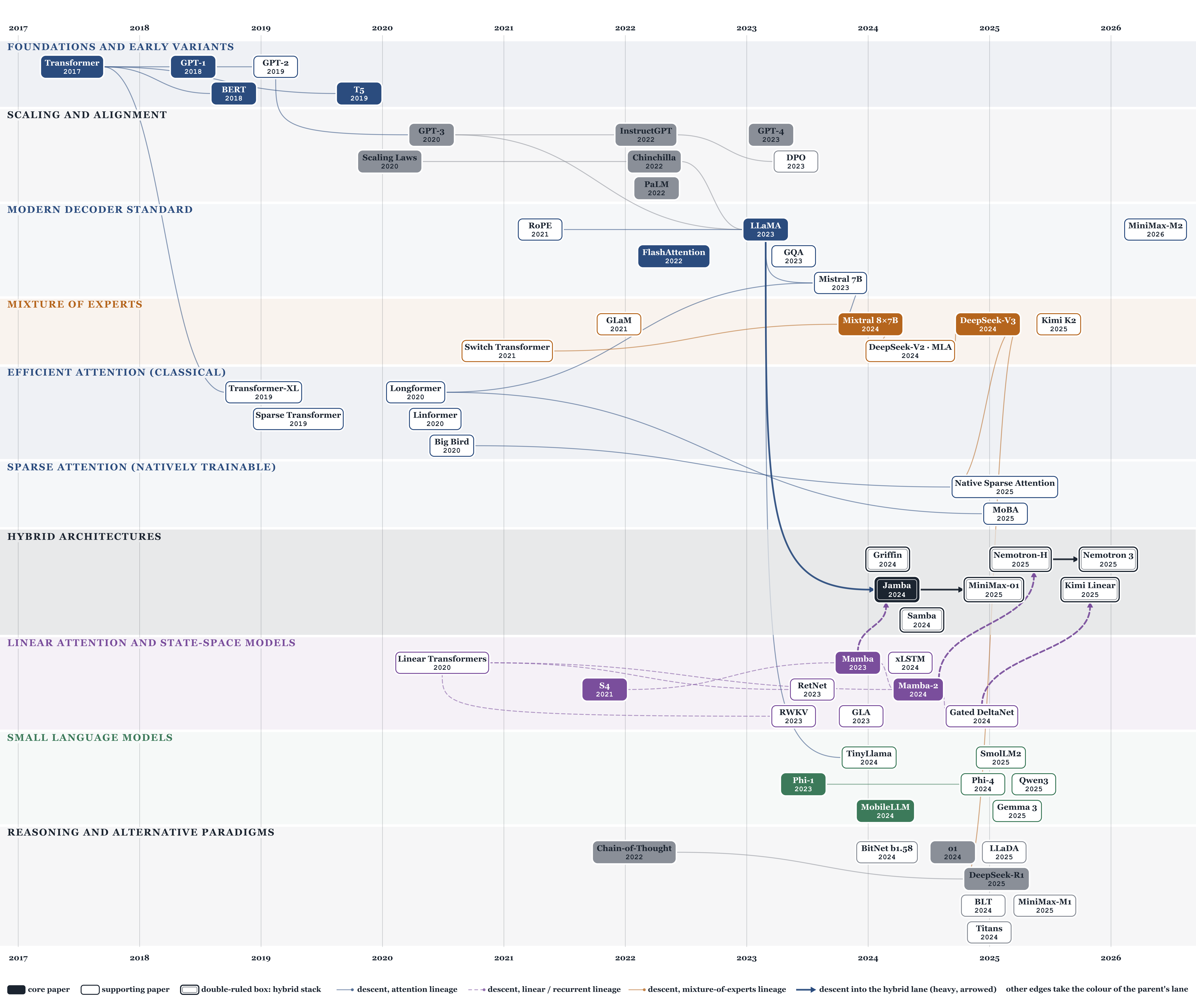
The Transformer of 2017 still sits at the core of every current large language model, yet almost everything around it has been rebuilt, some parts repeatedly. This survey traces the architectural development of text-only LLMs from 2017 to early 2026 as four epochs, each driven by a concrete bottleneck. In the exploration epoch (2018–2019), encoder-, decoder-, and encoder–decoder designs competed, and decoder-only prevailed for structural reasons that paid off only later. In the scaling epoch (2020–2022), capability was bought with parameters and data, while the first efficiency ideas failed for lack of a binding problem. In the efficiency epoch (2023–2024), inference cost became that problem: the field converged on the modern decoder recipe, attacked the KV cache factor by factor (GQA, MLA, sliding windows, paging), and revived mixture-of-experts and recurrent sequence mixing; nearly every mechanism was a rediscovery of a previously shelved idea. In the convergence epoch (2025–2026), independent model families arrived at the same design principle: a small minority of full-attention layers, interleaved with linear mixers and routed experts, retained to restore the exact recall that fixed-size states surrender. In parallel, reasoning models opened a test-time-compute axis whose cost lands on the same object: the memory a model carries per generated token. I synthesize four long-run development lines, compare the architecture families qualitatively, and state the open problems, including the 2026 dissent over the attention operator itself. Every core concept is explained once and in full, so the survey serves simultaneously as an introduction for students and a reference for researchers.
Keywords: large language models · Transformer · architecture survey · key–value cache · mixture-of-experts · state-space models · linear attention · hybrid architectures · test-time compute · scaling laws
Figure 1
Contents
- Introduction
- Foundations: The Transformer
- Epoch I: Exploration (2018–2019)
- Epoch II: Scaling (2020–2022)
- Epoch III: Efficiency and the Open Wave (2023–2024)
- Epoch IV: Convergence and New Axes (2025–2026)
- Synthesis: Nine Years in Four Lines
- Conclusion
Cite
@misc{reimann2026llmarchitectures,
  title        = {The Evolution of Large Language Model Architectures:
                  From the Transformer to Hybrid Models (2017--2026)},
  author       = {Reimann, Finn},
  year         = {2026},
  howpublished = {Preprint, version 1.0},
  doi          = {10.5281/zenodo.22785090},
  url          = {https://doi.org/10.5281/zenodo.22785090}
}